
Financing innovations that could help fund the African creative industries feat. Marie-Lora Mungai
Savannah Creatives #48


Hi guys,
Welcome to the new subscribers who joined the community this week! You are now 561 to follow Savannah Creatives Digest on Substack.
A few months ago, I invited Marie Lora-Mungai, CEO of Restless Global, a consultancy specialising in Africa's creative and sports industries, to facilitate a series of sessions on the creative economy and creative finance for an East African network of creative hubs in Addis Ababa.
Organised with the support of the French Embassy in Kenya through the Création Africa Fund, the workshop was hosted by the Habesha Creative Lab at Alliance Ethio-Française Addis Ababa and brought together creative hub managers from across the region, alongside contributions from innovation ecosystem leaders including ICE Addis and Tshimologong Innovation Precinct.
The programme sought to equip these organisations with the tools and knowledge needed to better support the entrepreneurs and creative businesses driving their local ecosystems.
And let me tell you: every single session hit the nail on the head.

I have already shared some of her insights in previous newsletters, which I strongly encourage you to read: “The creative funding paradox: why money is not flowing into the African creative industries” and “What makes a creative sector investable, from an investor’s perspective?”.
This time, I want to come back to a somewhat technical topic that generated a lot of discussion during the sessions: the relationship between creative industries and finance.
Here is what we’ll cover today:
Why the traditional VC funding model rarely works (for the African creative industries)
Five financing innovations that could help breach the gap
Enjoy the read,
Yours,
Maurice

🚨Quiz: are you an artist, a founder or a CEO?🚨
That’s the very unscientific yet disturbingly accurate personality test that Marie-Lora put together to help you clarify your creative personality! It’s also the first chapter of Creative Cash Flow, a very practical guide to building financially sustainable creative businesses in Africa. Check out the book here.
1. Why the traditional VC funding model rarely works (for the African creative industries)
First of all, a definition.
Private Equity (PE) is a type of investment where investors buy a stake in an established company and help it grow in value before selling their share for a profit.
There are essentially 3 types of equity investors.
Angels & High net worth individuals: business people successful in their field interested in investing in creative sector companies. They do small tickets, bring strategic and operative expertise. They might see themselves in the founders and decide to help. There are Angels networks all over the continent, and they’re quite important people to network with...
Impact funds: they’re close to the VC model, but want to achieve both returns AND impact (climate, job creation, women empowerment, etc.)
Venture Capital: those are targeting high growth/high risk scalable tech enabled companies. They have been very successful in the Western world.
To understand why the VC model rarely works in the context of African creative industries, we first need to understand its underlying logic.
VCs are governed by math. They invest in dozens of companies hoping that one or two will eventually generate 10x, 50x or greater returns, usually within a decade.
To make this work, VCs push founders to grow rapidly so the company can reach a much higher valuation and eventually be sold or acquired after a few years, allowing investors to cash out and realise their returns.
This model works well for technology companies with exponential growth potential, particularly in sectors such as fintech.
Most creative businesses, however, grow linearly rather than exponentially, and this creates a fundamental mismatch: either founders chase artificial growth, expand too quickly and burn through cash until the business collapses, or the business grows steadily but not fast enough to satisfy investors, who disengage and make follow-on funding harder to secure.
Neither outcome is desirable.
That said, there have been exceptions. These are companies that have built infrastructure around content rather than content itself: distribution, payments, marketplaces, tools or data.
Examples include Carry1st, which has raised $57 million to address key bottlenecks in Africa’s mobile gaming ecosystem, and Kenyan startup Wowzi, which has raised over $3 million by building technology that enables brands to coordinate thousands of nano-creators at scale.
In both cases, investors are backing scalable infrastructure businesses rather than creative productions themselves.
2. Five financing innovations that could help breach the gap
If venture capital is rarely the right tool for creative businesses, what alternatives exist?
The good news is that a growing number of financing instruments are emerging across Africa and globally. Each serves a different purpose, and understanding the difference can help creative entrepreneurs identify the right type of capital at the right stage of their journey.
(1) Debt: for profitable creative SMEs that need cash to grow.
Truth is most creative businesses do not need investors, but cash to run their operation and develop their activities :
A production company may have signed contracts worth $100,000 but still struggle to pay crews while waiting three months for clients to settle invoices.
A fashion brand may receive a large order but lack the cash needed to buy fabrics and manufacture products.
A music label may need to finance marketing campaigns before royalties start coming in.
This is where debt becomes useful: unlike investors, lenders do not care if your company becomes the next unicorn. They care whether you can repay the money.
The simplest form is a bank loan: you borrow a fixed amount, use it to grow the business, then repay it over an agreed period.
But debt can take other forms.
A working capital loan helps cover day-to-day expenses while waiting for revenue to arrive. For example, a production company may need to pay crews, equipment rentals and locations today, even though the client will only pay the final invoice three months later.
Invoice financing goes one step further. Instead of waiting three months to get paid, a lender advances part of the money against the invoice. When the client eventually pays, the lender recovers the advance and takes a fee.
Trade finance is designed for businesses that need to fulfil large orders. Imagine a fashion brand receives a $50,000 order from a retailer but lacks the cash to purchase fabrics and manufacture the collection. A lender provides the money needed to fulfil the order, which is then repaid once the customer pays.
In all three cases, the objective is the same: helping businesses bridge temporary cash-flow gaps without giving up ownership of the company.
In Kenya, HEVA Fund partnered with NCBA Bank to launch the Ota Loans programme, providing loans of approximately $5,000 to $40,000 to creative businesses. Similar initiatives are beginning to emerge elsewhere on the continent.
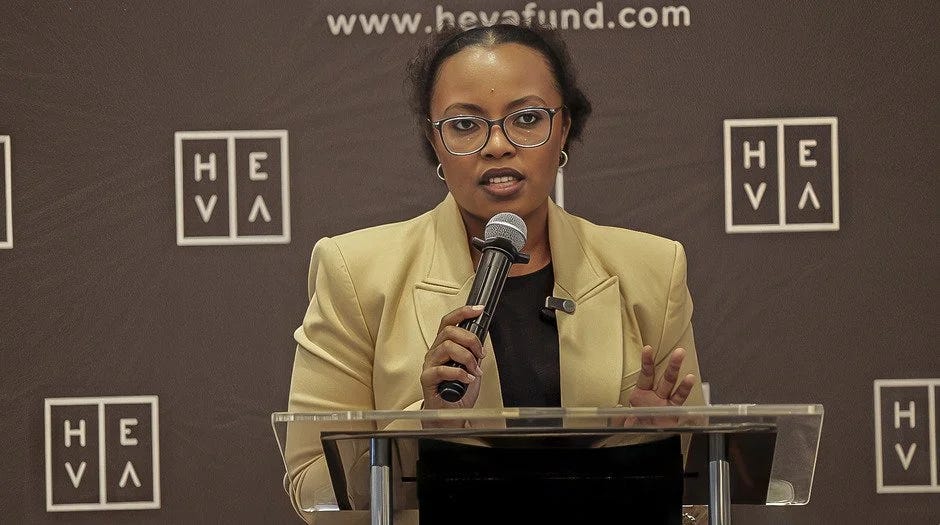
For many creative SMEs, debt should probably be the first serious financing instrument considered after self-funding.
2. Revenue-based financing: for businesses with predictable revenues but limited collateral.
Revenue-based financing provides capital in exchange for a percentage of future revenues.
Instead of repaying a fixed monthly amount, repayments rise and fall with sales. If business is slow, repayments are lower. If revenues increase, repayments increase too.
This makes the model particularly attractive for creative businesses whose income can fluctuate significantly throughout the year.
A creator, studio or digital platform might receive funding today and agree to repay a percentage of future sales, subscriptions or royalties until the advance has been recovered.
One of the best-known examples is Shopify Capital, which advances funds to merchants based on their sales history and recovers the money through a percentage of future transactions.
The model remains relatively rare in Africa but is increasingly discussed as a good fit for creative industries.
3. Blended finance & de-risking facilities: for emerging sectors that investors consider valuable, but still too risky to invest in.
Many creative businesses struggle to access finance because lenders and investors perceive the sector as too risky.
This is where blended finance and de-risking facilities come in.
Blended finance combines public and private capital. In practice, Development Finance Institutions (DFIs) such as Proparco, the World Bank or the African Development Bank (DFIs), or public institutions such as the European Union, absorb part of the risk of financing, making investments more attractive for private investors.
For example, a bank may hesitate to finance a film producer because it does not understand the sector or views creative businesses as too unpredictable. A guarantee facility can cover part of the potential losses, while technical assistance can help the bank better understand how creative businesses operate.
Concretely, this can take the form of guarantees, technical assistance or first-loss capital, that reduce the risks associated with lending to creative businesses.
This is the logic behind initiatives such as CREA Fund, launched by Proparco and the European Union. Rather than financing entrepreneurs directly, the programme works with banks, funds and financial intermediaries, helping them better understand creative industries while reducing the risks associated with financing them.
The entrepreneur may never interact with Proparco or the European Union directly, yet these mechanisms may be the reason a loan, investment or credit facility becomes available in the first place.
Without these instruments, many of the financial products currently available to creative entrepreneurs simply would not exist.
4. Micro-private equity and holding companies: for established businesses looking to scale.
Rather than betting on future potential like VC investors do, micro-private equity investors look for companies with proven revenues, recurring clients and a clear business model.
Their objective is not to chase explosive growth, but to help businesses become larger, stronger and more profitable.
In addition to providing capital, they often support founders with strategy, governance, financial management and business development.
One of the best-known examples in Africa’s creative industries is FilmHouse Group in Nigeria, as exemplified in the 2024 Success Stories in the Creative Industries in Africa report written by Restless Global and PwC for Proparco as part of the Global Gateway programme.

In 2014, the company received investment from African Capital Alliance, one of Africa’s leading private equity firms. Over the following years, FilmHouse expanded into a dominant player in cinema exhibition and film distribution, operating more than 50 screens across Nigeria and helping structure the country’s film ecosystem.
This approach can be particularly relevant for creative SMEs such as production companies, agencies, fashion brands, publishers or animation studios that have moved beyond the start-up phase but need capital and expertise to reach the next stage.
At a smaller scale, funds such as I&P have applied the same model across Francophone Africa, investing in businesses operating in fashion, publishing, advertising, production and digital commerce.
A related model is the holding company.
Rather than investing in a single business, a holding company acquires stakes in multiple companies and creates value by sharing resources, expertise and infrastructure across the group. This can include finance teams, distribution networks, technology platforms or administrative functions.
The logic is simple: several businesses working together can often achieve economies of scale that none could achieve alone.
For exemple, Helios Sports & Entertainment Group, backed by investors including Proparco and the International Finance Corporation (IFC), created a dedicated investment vehicle focused on sports, media and entertainment.
Rather than investing in one company, it is building a portfolio of complementary assets and intellectual property across the sector: NBA Africa, Afro Nation (via The Malachite Group), PFL Africa and other entertainment platforms. The thesis is that value is created not by a single artist, event or business, but by building an ecosystem around content, audiences, rights, events and distribution.
For creative industries, the holding company model remains largely underdeveloped, but it offers an interesting alternative to traditional venture capital by focusing on long-term value creation, synergies and shared infrastructure
5. Corporate venture capital: for businesses solving strategic industry problems.
Not all investors are financial investors.
Many large corporations operate their own investment funds, known as Corporate Venture Capital (CVC) funds.
Unlike traditional VCs, these investors are often looking for strategic value alongside financial returns.
A gaming company may invest in a distribution platform. A media company may invest in creator tools. A technology company may invest in businesses that strengthen its wider ecosystem.
The Sony Innovation Fund for instance has invested in companies such as Carry1st, which helps distribute and monetise digital content across Africa, as well as creator-economy businesses such as Wowzi, because they offer new pathways to distribution and monetisation for games and creators.

Corporate VCs are often interested in infrastructure, technology and services that strengthen an industry, rather than funding individual creative projects.
For founders building tools, platforms or enabling technologies, they can be valuable partners.
Did you like this edition?
Please share with a friend if you found this useful!
Remember we don’t build an ecosystem by withholding information and opportunities from one another: that’s a loser move.
If you wanna grow, it has to be with the wider community.
It’s a collective game.
So help us share the word! ;)